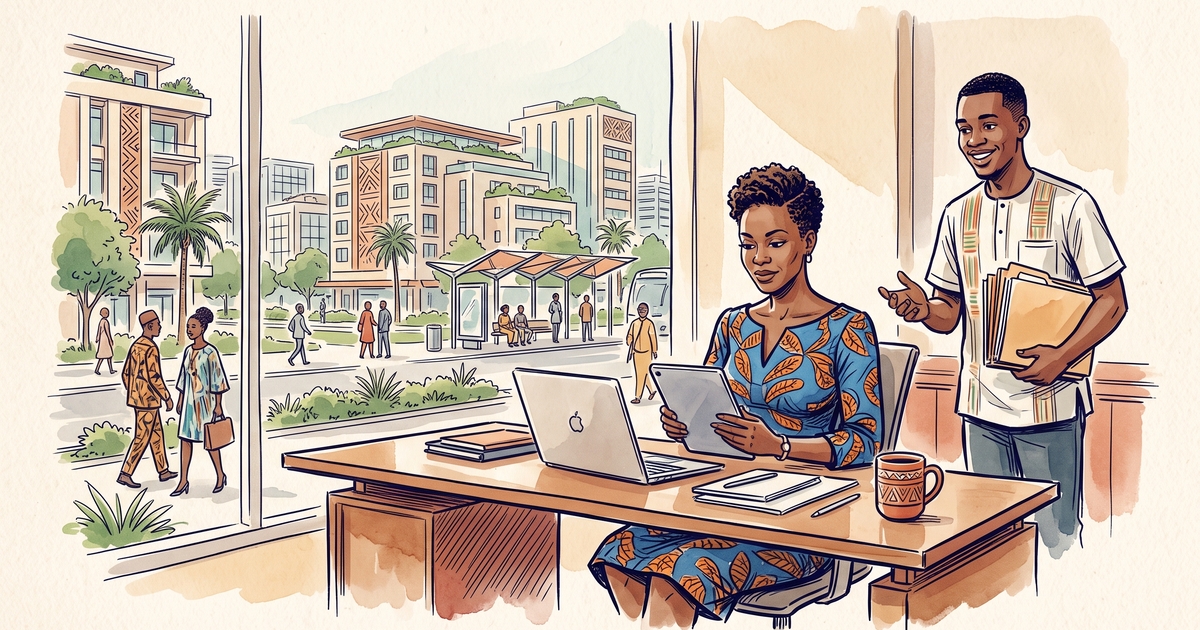
The braider has both hands deep in a client’s hair when the phone rings. There is no receptionist and no voicemail anyone checks - the call just dies. The caller wanted Saturday at ten. She will never know, and the caller is already dialing the next salon.
Run a team of one and you hold every job title at once: receptionist, bookkeeper, customer service, procurement, closing shift. The work that grows the business - and the craft the business is actually built on - gets whatever attention survives the interruptions. Most days, that is none.
Meanwhile the AI industry ships “copilots” by the dozen, all aimed at people with keyboards and three monitors. But the person drowning deepest in admin is not the analyst. It is the merchant whose hands are full.
The idea
Sika is an executive assistant for businesses of one - and it is a device first, not an app. The name is Akan for gold: a fitting name for the colleague whose job is to stop money from walking out the door. It sits on the counter the way a POS terminal does: a screen, a microphone, a speaker. And critically, its own phone number and its own email address.
Those two sound like details. They are the whole idea. A phone number and an email address are the minimum credentials of a colleague - they are what lets the world reach someone who works for you. Give them to software and it stops being a tool you open. It becomes staff you hired.
So Sika answers the phone while the owner’s hands are busy. Books the appointment. Replies to the email asking for a quote, drafting from the price list. Watches the day’s sales and says at closing what moved and what did not. And when it hits something it should not decide alone, it does what a good assistant does - it asks the manager, in one short message.
To make that concrete, I staged a demo with AI voices: a husband calls to book an anniversary surprise for his wife, Sika recalls her usual services from the salon’s records, hits a calendar conflict, checks with the owner, rearranges another customer’s slot, calls back, and emails the confirmation - to him only, so the surprise survives.
Listen to the demo call (3 min)
The form factor matters more than it looks. An assistant inside a phone competes with every other app for a screen the owner cannot touch mid-task. A device on the counter is there without being in the way - listening when spoken to, glanceable in passing, never something to dig out of a pocket. The POS terminal earned its place at the counter because that is where the money happens. Sika earns it because that is where the customers happen.
And the intelligence should live as close to that counter as possible. The shop’s sales, its customer list, its money conversations - that data stays in the shop. Local processing is not a constraint to apologize for; it is the trust story, the offline story, and the cost story all at once.
And notice what Sika is not: a secretary with a better voice. There is nothing reductive about answering phones - but an executive assistant is a different job. The good ones are optimized for how their executive thinks and works: they know the priorities, filter the noise accordingly, and prepare the decision before it is asked for. That is the bar. Sika is the owner’s logical extension, not the owner’s answering machine.
The interface question, meanwhile, is already settled - the industry is moving to voice because the evidence says it should. A Stanford study measured speech input at three times faster than typing, with fewer errors. a16z’s thesis on voice agents calls voice the first - and perhaps primary - way people will interact with AI, and argues it is what finally lets every business be available around the clock. So the wrong assumption left to correct is not about the interface. It is about the audience: the executive assistant has always been a corner-office privilege, while the people who need one most run businesses of one - the salon owner, the tailor, the spare-parts dealer, the food-truck cook. Each of them is an executive. None of them has ever had an assistant.
Why now
- The counter is proven distribution. Square and SumUp in the West, Yoco in South Africa, Moniepoint and OPay in Nigeria - merchants who never bought business software in their lives happily put a device next to the till, because the device touched money. Nigeria alone has over four million POS terminals in the field. The path from “app on your phone” to “box on your counter” has been walked, at scale, on every continent.
- Voice AI crossed the phone-call line. Real-time speech models now hold a conversation at a latency a caller will tolerate, and a wave of AI phone-answering services for small businesses is proving customers will book with a machine: Goodcall answers for thousands of local businesses, Slang.ai runs restaurant reservations, and Numa sits inside more than a thousand car dealerships.
- Small models keep getting better, and silicon keeps getting cheaper. Models in the Gemma, Phi and Qwen class already run on hardware that costs less than a POS terminal, and NPUs are becoming standard in cheap chips. The intelligence you can embed in a hundred-dollar box this year would have needed a server rack three years ago - and the curve only points one direction.
- The plumbing is a commodity. Programmable phone numbers, transactional email, WhatsApp Business APIs - everything Sika needs to face the world is rentable by the minute.
Product shapes
Three shapes, ordered by how much hardware conviction they demand:
- The companion number. Software only: a dedicated phone number and email inbox run by the assistant, managed from an app on the owner’s existing phone. Cheapest to build, fastest to test whether an AI colleague recovers real bookings.
- The counter companion. A locked-down, low-cost device - or honestly, a cheap Android phone on a stand running one kiosk app - that gives the assistant a physical presence: speaker, mic, glanceable screen. Cloud brain, local ears. This is where the “being there without being in the way” hypothesis gets tested.
- The full Sika. Purpose-built hardware with on-device inference. Calls answered on the box, business data never leaving the shop, working straight through an internet outage. The POS-grade ambition - and the version that earns the trust story completely.
Start with the first shape, but design every decision so the third stays reachable - because the device is the product, not a skin on the app. The companion number proves the assistant; the counter proves the presence; only then does custom hardware deserve to exist.
Who pays
The owner pays, and the budget is the missed call. For a service business, a missed call is usually a missed booking - real money with a number attached. One US study that listened in on 85 small businesses found barely a third of calls answered live - and most callers who hit voicemail never call back; they call the competitor. Price Sika against one recovered appointment a week, not against software subscriptions. A human assistant is a full salary in any city in the world; Sika does not need to be cheap. It needs to be cheaper than the person and better than the silence.
But the more interesting buyer might be the company that already owns the counter. Merchant-payment companies live and die by retention, and they are running out of payment features to differentiate on. An assistant that answers the merchant’s phone is the kind of feature that makes leaving unthinkable. The merchant has the problem; the fintech has the budget and the distribution. That mismatch - and how you navigate it without becoming a feature in someone else’s box - is the founder’s call to make.
Honest reckoning
- Hardware is where startups go to die in public. Humane raised 230 million dollars, shipped fewer than ten thousand AI Pins, and was sold to HP for half of what it raised; the Rabbit R1 survives mostly as a cautionary tale. Both were funded beyond anything a seed founder will see. The question to sit with: what does a custom device do that an eighty-dollar Android phone on a stand cannot? If the answer is “nothing yet”, start with the phone and let the device earn its existence.
- The trust threshold is binary. A human assistant who books one wrong appointment gets corrected; software that does it gets unplugged. The escalation design - what Sika decides alone, what it asks the manager, how it fails mid-call without losing the customer - is not a feature. It is the product.
- Local processing is a bet on a curve that has not finished bending. Today, the models that hold a phone conversation a customer cannot tell from staff live in the cloud. The gap will close - but it may close last exactly where Sika needs it most: real-time voice, in local languages, under real shop noise.
- Customers do not call in standard anything. A shop in Cotonou takes calls in French, Fon and Yoruba, sometimes in one sentence. Code-switching, accents and trade languages are not edge cases here; they are the call volume.
- In much of Africa and Asia, the business phone number is a WhatsApp number. Sika’s “own phone number” may need to be a WhatsApp Business identity first and a dial tone second - which places a platform Sika does not control in the middle of the product.
- Platform risk runs both directions. Square, Shopify or Moniepoint could each bolt an AI receptionist onto hardware they have already shipped - and a receptionist is exactly what a platform feature will be. Sika’s defensible ground is the gap between answering calls and being an executive assistant: the context, the judgment, the briefing - plus the local-first stance. Not the box.
- Even the biggest voice bulls hedge. The same a16z thesis cited above warns that voice for the sake of voice can be a net negative next to text. Sika’s case rests on hands-busy contexts - that ground has to be defended with usage data, not vibes.
- And the quiet one: an assistant with access to the sales data, the customer list and the owner’s communications is a serious thing to put in a small shop. Local processing is also the privacy answer - but only if it is true, verifiable, and explainable to an owner who will never read a privacy policy.
Monday morning
- Spend a full day inside each of five one-person businesses - a salon, a garage, a tailor, a restaurant, a shop. Count the interruptions. Count the missed calls. Ask what each missed call was worth.
- Run the wizard-of-oz version: a rented number forwarded to an off-the-shelf voice agent, answering for one salon for two weeks. Measure recovered bookings, not conversation quality.
- Test the form factor for a hundred dollars: a cheap Android phone locked to a single kiosk app, on a stand, on the counter. Does the owner talk to it? Does its being there change anything? That is the device hypothesis, falsifiable for almost nothing.
- Talk to a merchant-payments company about what their merchants ask for after payments. If “someone to answer the phone” is not on the list, find out why.
- Sit with one owner and write Sika’s first job description together: the ten things it may do alone, the five it must always escalate. If you cannot fill the first list, the product is not ready - and you just learned that for free.
Every healthy business of one eventually hits the same wall: more business than owner. The first hire is the scariest line item there is, and most never afford it. Maybe the first hire does not have to be a person.
Greenfield ideas are free to take. No strings attached.
But if you are building seriously in this space, I would love to compare notes - reach out on LinkedIn. I mentor founders who commit, and I invest in the ones who ship.