The first time I tried to build IKOUĒ, it failed.
Not “pivoted.” Not “wound down gracefully.” It failed. That was more than fifteen years ago, and for a long time I assumed that was the whole story.
Late in 2023, I started it again.
If anything, the ground was harder this time. There was almost no precedent for what we were attempting. No startup ecosystem to plug into. Very little funding moving through the country. Very few examples of anyone doing this, and no playbook to copy.
It was, in the truest sense of the word, greenfield. Untouched ground - nothing to displace, and nothing to lean on either. I have written before about what it takes to build in that kind of dark. This is the same ground, a few years on.
Early on, an investor told me something I have never been able to forget.
“If you can make this work in the Central African Republic, come back and see me. I’ll gladly invest. Because if it works there, it’ll work anywhere.”
He meant it as encouragement. I heard it as a fairly precise measure of how uncertain this was.
So what makes someone walk back into the exact thing that already beat them once? Not optimism. Something I had spent the fifteen years in between slowly building. That is what this piece is about.
You Are Not a Magician
When you build something genuinely hard, you cannot predict the future.
You cannot rely on certainty - there isn’t any. In a place like Bangui you cannot even rely on money to bail you out, because there isn’t much of that either.
So what is actually left to rely on?
Your judgment. That is the whole inventory. And your judgment, made visible and durable, is a plan.
This is where I want to flip the most over-used piece of advice in any founder’s life. We are told to trust the plan as if the plan were a thing with its own authority, something external you submit to.
You are not trusting the plan. You are trusting the judgment that built it.
That distinction matters, because it tells you where the work actually is. You do not get a trustworthy plan by writing a better document. You get one by becoming someone whose judgment is worth following - and that takes years.
Pillar One: Find Your Queen
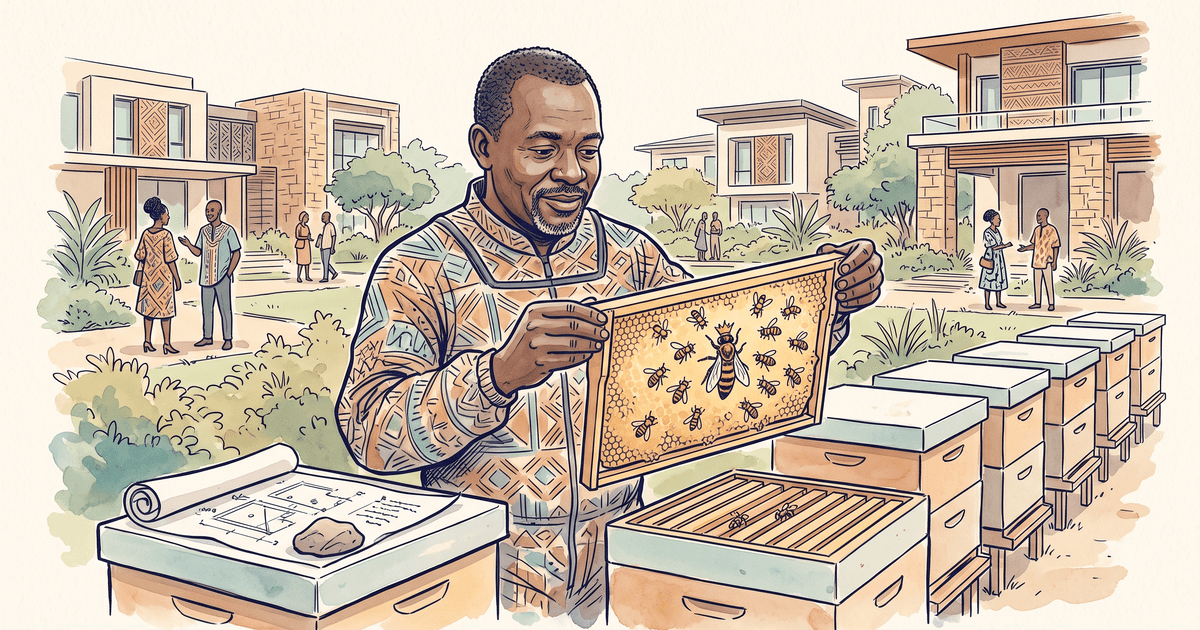
The idea of a Queen Bee Role is not mine. It comes from Mike Michalowicz’s Clockwork.
The premise is simple. Every organization has one activity that matters above all the others - the one thing that, if it stops, everything else stops being worth anything. You find it, and you protect it.
For me, the Queen Bee was never coding. It was not operations. It was not management, and it was not fundraising.
It was vision - though not the grand-future kind. More precisely, it was reading risk. Taking a plan and asking what could go wrong, how badly it would cost us, and what we could do now to keep us from ever getting there. Seeing the patterns, connecting the parts that look unrelated, and steering around the futures I do not want. Less predicting what comes next than making sure the worst of it never arrives.
That is the thing I do best without trying. Everything else, I can delegate.
Once I admitted that, I stopped trying to be everywhere at once. I got much better at trusting other people - not despite delegating, but because I finally understood the one thing I should never delegate.
Your Queen Bee is not your job title, and that takes the longest to accept. It is the thing that creates disproportionate value when you do it. Finding it can take years, sometimes decades. It comes out of experience, out of mistakes, out of slowly noticing where you have unusual leverage.
It took me a failure fifteen years ago and most of the time since to name mine. Looking back, that first IKOUĒ did not die because the vision was wrong. It died, more than anything, because I had not yet learned which part of it only I should be holding.
Pillar Two: Build the Systems
Knowing your Queen tells you where to put yourself. Systems decide whether anything you build outlasts your worst days.
The reference here is James Clear’s Atomic Habits, and the line everyone already half-remembers: you do not rise to the level of your goals, you fall to the level of your systems.
My own version is blunter. Motivation disappears. Discipline goes up and down. Energy comes and goes. Systems stay.
And the purpose of a system is not what most productivity advice claims. It is not efficiency. It is continuity. A system is what keeps you moving on a day when you feel nothing for the work at all.
In practice, the systems are unglamorous: weekly planning, written decisions, documentation, operating principles, a steady meeting cadence, real delegation, feedback loops.
What they all have in common is this - they protect what matters from your emotions.
But the most important system was never a process. It was people.
I did not get here alone, and it would be dishonest to write this as if I had. A team carried the work on the stretches where I could not. Partners took on the parts that were never my Queen Bee and did them better than I ever would have. “Trust your own judgment” only holds up because, around me, other people’s judgment quietly covers everywhere mine runs out.
So when I say build the systems, I mean this most of all: build the people, and earn the trust that lets you hand them what you should not be holding. That is the system that actually carries you.
And you will get the people part wrong sometimes. A hire who turns out to be a mismatch. A partnership that does not hold. That is exactly why the other parts have to be sound: when one piece slips, a plan with a stable core, judgment you have actually earned, and the rest of the system doing its quiet work absorb the shock between them. A well-built system does not need every part to be right at once. It balances itself out and corrects course. That is the whole reason you build it before you need it.
Pillar Three: Trust the Plan
A system will keep you moving. It will not tell you whether you are moving toward anything worth reaching. That is the plan’s job, and trusting it is the hardest discipline of the three.
Vision on its own is useless. Everyone has ideas. Everyone has dreams and vision boards. The hard part is turning a vision into a coherent plan - not a perfect one, a coherent one.
And the moment a real plan exists, everything around you begins, quietly and constantly, to argue for abandoning it. Bad months. Failures you did not see coming. People leaving. Funding that does not arrive. Delays. Criticism. Your own doubt, which is the loudest of all.
If your answer to each of these is to change direction every six months, the plan never gets the time it needs to compound. You keep uprooting the thing before it can grow.
This is the nuance people miss: trusting the plan is not refusing to adapt. The tactics change all the time. The roadmap evolves. The details get better. But the core direction should stay surprisingly stable.
The plan I wrote at the start of this second attempt and the thing running today are nowhere near identical in their details. The execution got far better. A hundred tactics changed. But the core direction never moved - the mission is the same one I set out with. Only the quality of how we pursue it grew up.
You can see where that plan has arrived: ikoue.com.
Where the Three Connect
Each pillar answers a different question, and only one of them.
The Queen tells you what to spend your energy on. The System tells you how to keep moving when you no longer feel like it. The Plan tells you where all that motion is supposed to lead.
Take one away and you can feel the failure mode immediately:
- Without the Queen, you work on everything, so nothing gets your best.
- Without Systems, you eventually stop moving at all.
- Without the Plan, you move fast in random directions.
These three do not arrive together, and I wish I had understood that earlier.
They develop on separate clocks. Some people already know their Queen but do not yet trust themselves. Some have a plan but no systems to carry it. Some have impeccable systems and are climbing the wrong mountain entirely.
If you feel lost right now, you are probably not missing everything. You are most likely just in different phases on each of the three. Keep working. Eventually they connect - and when they do, something genuinely changes.
The Part I Can’t Promise You
I have to be honest about the limits of all this, because the neat version above is a little too clean.
For one, I am telling you a story that is still being written. The second IKOUĒ is barely more than two years old. I am describing a plan that is compounding, not one that has finished proving itself - and the first version, remember, failed outright. That is exactly the kind of story that hides every founder who trusted a coherent plan, gave it years, and still watched it collapse. Survivorship is doing quiet work in every sentence I just wrote.
The three neat pillars are a comfort I only get with hindsight, too. Lived forward, none of it arrived in order or on schedule. It was messier, slower, and far less sure of itself than three tidy headings make it look.
There is also a darker twin to all of this. “Trust the plan” and “refuse to admit it isn’t working” look exactly the same from the inside. I do not have a clean test for telling them apart in the moment. Anyone who says they do is selling something.
And trusting your judgment assumes the judgment is sound. You can trust judgment you have not earned yet - that is just confidence dressed up as wisdom, and it is most dangerous precisely when you cannot tell the difference.
So I will not tell you to believe in yourself. That is the cheap version, and it skips the part that matters.
What got me through was not confidence. It was not motivation, and it certainly was not certainty. By the end, I was relying on something quieter: a judgment I had spent years making worth relying on.
That is the only thing I would offer anyone standing where I stood in 2023. Do not try to borrow conviction. Develop yourself until your own judgment becomes something you can actually trust - and then give the plan the time it deserves.
That trust cannot be borrowed. It has to be earned. The good news is that earning it is entirely up to you.
Where the Plan Goes Next
I will end with the most honest thing I can, which also happens to be an ask.
Everything above is theory until it meets logistics. And where I build, logistics is where good plans go to die.
We learned that the hard way. After our first cohort, we had to cancel a mobile development course outright - not for lack of students, not for lack of talent, but because they could not launch a single build on the machines they had. The ideas were there. The hardware was not.
That is the real ceiling over creativity here. Not ability. Equipment, power, a room that simply works.
So the next concrete step in the plan has a name: the first IKOUĒ Center. Somewhere to do more, and do it faster - to run our AI program with the little hardware people barely have today, and to stop turning capable people away because the logistics beat them first.
We are opening this up for support. To the diaspora first - because this is home before it is anyone’s cause - and to any foundation or research program that wants to build with us rather than for us.
If any of this resonated, that is the most useful place to put it. You can see what we are building, and reach out, here: the IKOUĒ Centers.
The plan does not need you to be sure it will work. It needs a room, some machines, and a few people willing to bet on a place most have already written off. If that is you, the door is open.